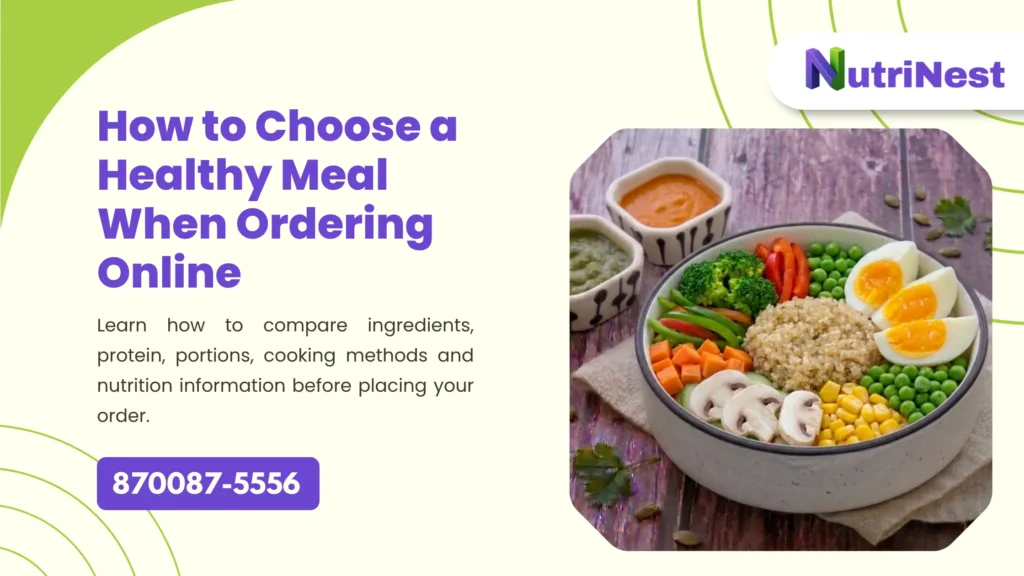
How to Choose a Healthy Meal When Ordering Online
How to choose a healthy meal when ordering online can feel surprisingly difficult.
You open a food delivery app intending to eat something sensible – but you are suddenly looking at dozens of restaurants, tempting pictures, oversized portions, combo offers and unfamiliar menu descriptions.
A meal can also sound healthy without necessarily being balanced. Words such as “grilled,” “protein,” “multigrain” or “healthy” do not tell you everything about the meal.
The good news is – that you don’t need to calculate every calorie or understand complicated nutrition labels to make a better choice.
A few simple checks can help you identify healthy meals to order online – while still enjoying your food.
Start With the Meal, Not the Restaurant
When ordering online – it is easy to choose a restaurant first and then search its menu.
Try reversing the process.
First decide – what kind of meal you actually need.
Are you looking for –
- A light lunch?
- A filling dinner?
- A high-protein meal after exercise?
- A healthy evening meal?
- Something with plenty of vegetables?
- A complete meal rather than a snack?
Once you know what you want from the meal – menu choices become easier to compare.
For example – if you need a proper lunch, choosing only a small salad because it looks “healthy” may leave you hungry an hour later.
A better approach is to look for a balanced meal – that provides a combination of protein, vegetables, carbohydrates & appropriate fats.
What Makes a Meal Healthy?
There is no single definition of a “healthy meal” – that works for everyone.
Your – age, activity level, dietary preferences and individual nutritional needs all matter.
However – a useful starting point is variety and balance.
The World Health Organization describes a healthy diet in terms of adequacy, balance, moderation & diversity – with an emphasis on minimally processed or unprocessed foods.
That means – you should look beyond whether a dish has fewer calories.
Instead, ask:
- What does this meal actually provide?
- Does it contain a meaningful protein source?
- Are there vegetables or other fibre-rich foods?
- Is the carbohydrate source appropriate for the meal?
- Is it heavily fried?
- Is the portion reasonable?
These questions are usually more useful than simply searching for the lowest-calorie item.
1. Look for a Clear Protein Source
Protein is one of the first things worth checking when choosing healthy food to order online.
Depending on your diet, protein could come from:
- Eggs
- Chicken
- Fish
- Paneer
- Tofu
- Soya
- Beans
- Chickpeas
- Lentils
- Other legumes
Protein can make a meal more satisfying and is important for maintaining & building body tissues.
If you are physically active, you may also deliberately look for high-protein meals.
But don’t assume that a dish is high in protein simply because the menu uses the word “protein.”
Check what the actual protein source is and, where available, look at the nutrition information.
For people specifically looking for protein-focused options, you can also explore our guide to High Protein Meals in Faridabad.
2. Don't Ignore Vegetables and Fibre
A meal containing protein is useful, but protein alone doesn’t make it balanced.
Look for – vegetables, salads, legumes, whole grains & other fibre-rich foods where appropriate.
Vegetables can add – volume, variety & important nutrients to a meal.
If your usual online order is something like a burger and fries – you don’t necessarily need to completely change your eating habits overnight.
You could start by choosing a meal that includes vegetables or a side salad, or select a bowl with vegetables and a suitable protein source.
Small changes are often easier to maintain – than trying to completely overhaul your diet – every time you order.
3. Pay Attention to How the Food Is Cooked
The cooking method can tell you something about the meal.
Grilled, baked, roasted, steamed or lightly cooked options may be preferable – when you are trying to avoid meals that are heavily fried.
But don’t treat cooking methods as absolute rules.
A grilled meal can still be high in calories depending on sauces, cheese, dressings & portion size.
Similarly – not every food that is cooked with oil is automatically an unhealthy choice.
The bigger picture matters.
Instead of asking:
“Is this food fried?”
also ask:
“What else is in the meal?”
That gives you a much more realistic way – to evaluate healthy meal options.
4. Be Careful With Sauces and Dressings
Sometimes the main ingredients of a meal look perfectly reasonable – but sauces & dressings can significantly change the overall meal.
Creamy sauces, mayonnaise based dressings, cheese sauces & sugary sauces – can add substantial amounts of fat, sugar or sodium.
This doesn’t mean you need to avoid sauces completely.
If the restaurant allows customization, consider –
- Asking for dressing on the side
- Choosing a lighter dressing
- Reducing creamy sauces
- Avoiding multiple sauces in the same meal
This is particularly useful when ordering salads.
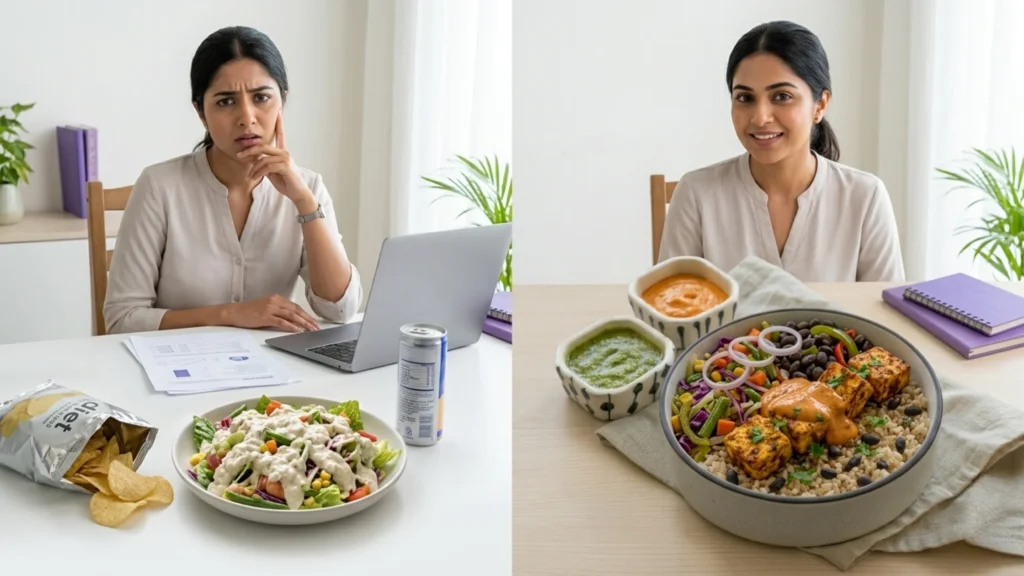
A salad is not automatically a light meal simply – because it contains vegetables.
The dressing, cheese, fried toppings and portion size – can all matter.
5. Don't Automatically Choose the Lowest-Calorie Meal
When people search for healthy food choices, they sometimes focus almost entirely on calories.
Calories are relevant – but they are only one part of the picture.
A very small meal may contain relatively few calories – but leave you hungry soon afterwards.
That can result in additional snacking or another order later.
Instead – consider the meal’s overall composition.
A satisfying meal may include –
Protein + vegetables/fibre + suitable carbohydrates + appropriate fats
The exact quantities will vary from – person to person.
The objective is not to – find the smallest meal on the menu.
It is to find a meal – that fits your hunger and nutritional needs.
6. Check Portion Size Before Ordering
Online food ordering makes portion sizes difficult to judge.
A menu photograph can make a dish look smaller or larger than it actually is.
If nutrition or serving information is available – use it.
You can also look at reviews or menu descriptions for clues about portion size.
If the serving is particularly large – you don’t necessarily have to finish everything in one sitting.
You can save an appropriate portion for later if the food can be safely stored.
Portion awareness is especially useful when ordering calorie dense foods – such as creamy pasta, biryani, loaded wraps, desserts or fried meals.
7. Read the Menu Description Carefully
Don’t order based only on the photograph.
Read the description.
Look for information about:
- Main ingredients
- Protein source
- Vegetables
- Cooking method
- Sauces
- Cheese
- Fried toppings
- Portion size
- Customization options
A menu description can reveal details that aren’t obvious from the photograph.
For example, a “healthy bowl” could contain vegetables, grains and protein — or it could contain a large amount of creamy dressing and fried toppings.
The name is not enough.
Read what you’re actually ordering.
8. Look for Nutrition Information When Available
Some restaurants provide detailed nutrition information – while others don’t.
When available – information about calories, protein, carbohydrates and fats can make comparison easier.
You don’t need to obsess over individual numbers.
Use them as a guide.
For example – if you are comparing two similar meals & one provides significantly more protein while having a similar overall composition – that information may help you make a more informed choice.
Nutrition information is particularly useful for – people following specific fitness or dietary goals.
However, numbers should still be considered in context rather than treated as a simple “good” or “bad” score.
9. Don't Let Healthy on the Menu Make the Decision for You
This is one of the most important rules for healthy online food ordering.
Marketing language can influence how we perceive food.
A dish might be described as –
- Healthy
- Fitness
- Protein-rich
- Multigrain
- Wholesome
- Clean
- Light
But these words don’t automatically tell you the complete nutritional picture.
Instead of trusting the label – look at the ingredients and preparation.
This doesn’t mean restaurants are misleading customers.
It simply means – that menu names are not a substitute for understanding what you’re eating.
10. Choose a Complete Meal Instead of Random Snacks
One reason online orders can become excessive is that – people order several small items instead of one satisfying meal.
For example –
Snack → drink → fries → dessert → another snack later.
Sometimes a complete meal would have been more satisfying.
If you are actually hungry – consider ordering a proper meal containing a suitable protein source, vegetables and other foods that fit your dietary needs.
This can make the eating experience more satisfying and reduce the feeling – that you are constantly looking for something else to eat.
What Is the Healthiest Food to Order Online?
There isn’t one universally healthiest food to order.
A suitable choice depends on your – dietary preferences, hunger and nutritional requirements.
However, when comparing healthy food to order online, meals built around simple ingredients are often easier to evaluate.
For example –
- Grilled chicken with vegetables and a suitable grain
- Paneer or tofu bowl with vegetables
- Egg-based meal with vegetables
- Chickpea or bean salad
- Balanced grain bowl with a protein source
- Vegetable and protein-rich wrap
- A well-composed salad with a satisfying protein source
The key is not the specific dish.
It is the overall composition.
How Do You Choose Healthy Food on Zomato or Swiggy?
If you use food delivery platforms such as Zomato or Swiggy, don’t rely exclusively on filters labelled “healthy.”
Use the menu itself to make your decision.
A simple process is:
Step 1: Decide what type of meal you need.
Step 2: Look for a clear protein source.
Step 3: Check for vegetables or fibre-rich ingredients.
Step 4: Look at the cooking method.
Step 5: Check sauces, dressings and fried toppings.
Step 6: Review portion size and nutrition information if available.
Step 7: Choose a meal that will actually satisfy you.
This takes only a few minutes but can significantly improve your food choices.
What Should You Order When Trying to Eat More Protein?
If increasing protein is one of your goals, start by identifying the protein source before looking at anything else.
Eggs, chicken, paneer, tofu, soya, beans and chickpeas can all contribute protein to a meal.
Then build around it.
For example –
Protein + vegetables + appropriate carbohydrate
is generally more useful than simply ordering an item because its name contains “protein.”
Also remember that – your total protein intake across the day matters more than whether one particular meal contains an unusually large amount.
What About Healthy Meals for Lunch?
Lunch can be particularly challenging for people working from offices.
You may have limited time – several meetings and plenty of convenient takeaway options nearby.
A practical lunch should ideally be satisfying enough to carry you – through the afternoon without making you feel excessively heavy.
Look for meals with:
- A good protein source
- Vegetables or salad
- A suitable carbohydrate source
- Reasonable portions
- Moderate use of sauces and fried components
If lunch is one of your biggest daily challenges, our guide to Office Lunch Delivery in Faridabad explores ways to make weekday meals more convenient.
Is Ordering Healthy Food Better Than Fast Food?
It depends on what you order.
“Ordering online” isn’t itself unhealthy.
You can order a balanced meal online, just as you can order a meal that is high in calories, sodium, saturated fat or added sugar.
The important distinction is the food choice.
This is why healthy food delivery can be useful for people who want convenience without making fast food their default option.
The goal isn’t to make every online order perfect.
It is to make better choices more consistently.
How to Avoid Overeating When Ordering Online
Online ordering can make it very easy to order more food than you actually need.
Before placing the order, ask yourself –
“How hungry am I?”
Then order accordingly.
You can also avoid automatically adding:
- Large sides
- Sugary drinks
- Multiple starters
- Combo upgrades
- Desserts
unless you genuinely want them.
If you do want a treat, enjoy it.
Healthy eating doesn’t require – eliminating every food that isn’t considered “healthy.”
It’s the overall pattern that matters.
Can Healthy Meal Delivery Make Eating Well Easier?
For some people, the biggest challenge isn’t knowing what healthy food looks like.
It is having the time to prepare it.
Grocery shopping, cooking and cleaning – can make healthy eating difficult on busy days. This is particularly true for working professionals or people living alone.
That is where prepared healthy meal delivery can become a practical option.
NutriNest, for example, offers meals such as salads, wraps, bowls and protein-focused options for people looking for convenient prepared food.
If you regularly need prepared meals, you can also explore Healthy Meal Subscription Plans in Faridabad as a way to make healthy eating more structured.
A Simple Checklist Before You Click – Order
The next time you order food online, run through this quick checklist –
✓ Does the meal contain a clear protein source?
✓ Does it include vegetables, legumes or other fibre-rich foods?
✓ How is it cooked?
✓ Are there heavy sauces or dressings?
✓ Is the portion appropriate for my hunger?
✓ Is nutrition information available?
✓ Am I ordering because I’m hungry or simply because the food looks tempting?
✓ Will this meal actually keep me satisfied?
You don’t need to get every answer right every time.
The purpose is simply – to make your decision more deliberate.
The Bottom Line
Knowing how to choose a healthy meal when ordering online doesn’t require – becoming an expert in nutrition.
Start with the basics.
Look for a balanced meal. Check the protein source. Include vegetables or fibre rich foods. Pay attention to cooking methods, sauces and portion sizes. Read the menu description instead of – relying only on the food photograph.
Most importantly, don’t think of healthy eating as choosing between “perfect” food and junk food.
There is a wide middle ground.
You can order food online and still make a thoughtful choice.
And when your schedule is too busy to cook regularly – having convenient healthy meals available can make that choice easier to repeat.
Healthy eating becomes much more practical when you focus not on making one perfect order, but on making better food choices consistently.
A Quick Note from NutriNest
At NutriNest, the focus has always been simple –
Clean, balanced, and consistent meals
Built for:
- Daily ordering
- Busy lifestyles
- Health-conscious choices
You can explore and order directly on:
And if you’ve already tried NutriNest—your review truly makes a difference.
Frequently Asked Questions (FAQs)
1. What is the healthiest food to order online?
There is no single healthiest food – for everyone. A balanced meal containing “a suitable protein source, vegetables or other fibre rich foods and an appropriate carbohydrate source” can be a practical choice. Look at the ingredients, preparation method & portion size – rather than relying only on the dish name.
2. How do I choose healthy food on Zomato or Swiggy?
Start by deciding – what type of meal you need. Then check the – protein source, vegetables, cooking method, sauces, portion size and available nutrition information. Don’t rely solely on filters or labels – such as “healthy” or “fitness.”
3. What should I order when trying to eat healthy?
Look for meals built around simple, recognizable ingredients – such as ‘a protein source combined with vegetables and a suitable carbohydrate.” Grilled, roasted or lightly prepared options can be useful – but check sauces and toppings as well.
4. How can I order healthy food without overeating?
Choose a portion – that matches your hunger and avoid automatically adding large sides, sugary drinks or combo upgrades. If the serving is large – you can consider saving an appropriate portion for another meal, provided the food can be stored safely.
5. Is healthy food delivery a good option for busy people?
It can be a practical option for people – who want nutritious meals but don’t have enough time to “shop, prepare and cook regularly.” The quality of the service still matters – so check its menu, ingredients, nutrition information where available & food preparation practices – before making it part of your routine.