What Makes a Meal Actually Healthy?
A meal can look healthy and still be unbalanced.
A bowl of salad may be nutritious – but it may not provide enough “protein or energy” to keep you satisfied. A low calorie meal may sound like a “healthy choice” – but calories alone don’t tell you – whether a meal provides the nutrients your body needs. Even a homemade meal isn’t automatically balanced.
So – what makes a meal actually healthy?
A healthy meal is generally one that brings together – a useful combination of nutrients & foods – such as “vegetables or other fibre rich foods, a source of protein, appropriate carbohydrates and some healthy fats”, while keeping highly processed ingredients, excess sugar, salt & unhealthy fats in moderation.
The exact balance can vary depending on your – age, activity level, dietary preferences and individual needs. WHO describes a healthy diet – around four broad principles: adequacy, balance, moderation & diversity.
Let’s break that down into something you can actually use – when deciding what to eat.
A Healthy Meal Is More Than Just "Low Calorie"
One of the most common mistakes is – assuming that fewer calories automatically means “healthier food.”
Calories matter – particularly when you’re managing your overall energy intake. But calories don’t tell the whole story.
For example, two meals can contain a similar number of calories while being very different in:
- Protein
- Fibre
- Vitamins and minerals
- Type of carbohydrates
- Type and amount of fat
- Added sugar
- Sodium
- How filling the meal is
That is why looking only at calories can give you an incomplete picture.
Instead of asking:
“How few calories does this meal have?”
also ask:
“What am I getting from these calories?”
A nutritious meal should contribute useful nutrients – rather than simply being small.
1. Start With a Good Source of Protein
Protein is an important part of a balanced diet and can come from both plant and animal foods.
Depending on your dietary preferences – protein sources can include:
- Eggs
- Chicken
- Fish
- Paneer
- Milk and other dairy foods
- Tofu
- Soy products
- Lentils and dals
- Chickpeas
- Beans
- Other pulses
- Nuts and seeds
You don’t necessarily need to calculate – the exact amount of protein in every meal.
A simpler approach is to look at your plate and ask:
“Where is the protein?”
If the answer isn’t obvious – the meal may need a more substantial protein source.
For someone who exercises regularly – protein may be especially important to consider across the day’s meals. However, individual protein requirements vary – so there isn’t one protein amount that makes every meal healthy for everyone.
If you’re specifically trying to increase your protein intake – you may also find our guide on How Much Protein Do You Actually Need Every Day? useful.
2. Include Vegetables and Other Fibre-Rich Foods
Vegetables add much more than colour to a meal.
They can contribute fibre, vitamins, minerals and other nutrients – while also adding volume and variety.
WHO recommends that people over 10 years of age aim for at least 400 grams of fruits and vegetables per day – along with at least 25 grams of naturally occurring dietary fibre per day. These are daily recommendations, not a requirement to put a particular amount on every plate.
Good options include:
- Leafy vegetables
- Carrots
- Cucumbers
- Tomatoes
- Capsicum
- Beans
- Cauliflower
- Broccoli
- Peas
- Other seasonal vegetables
- Fruits
- Lentils and pulses
- Whole grains
This is also why a meal that contains only refined carbohydrates & a small amount of protein – may not be as balanced as a meal that includes vegetables, legumes or whole grains as well.
3. Carbohydrates Are Not the Enemy
Healthy eating doesn’t mean “eliminating carbohydrates.”
Carbohydrates are an important source of energy and WHO recommends that they come primarily from sources – such as “whole grains, vegetables, fruits & pulses.”
Depending on your meal and dietary needs, carbohydrate sources can include:
- Whole wheat
- Oats
- Brown rice
- Millets
- Other whole grains
- Potatoes & other starchy vegetables
- Beans and lentils
- Fruits
The quality & overall composition of the meal matter.
For example, a meal built around whole grains, vegetables and a protein source – is quite different from a meal dominated by refined carbohydrates, added sugar and heavily processed ingredients.
So rather than asking:
“Does this meal contain carbs?”
ask:
“What type of carbohydrates does this meal provide, and what else am I eating with them?”
4. Don't Forget Healthy Fats
Fat is another nutrient that doesn’t need to be completely removed from a “healthy diet.”
Foods such as nuts, seeds, some fish and certain plant oils – can provide unsaturated fats. WHO recommends favouring unsaturated fats – over saturated fats and limiting trans fats.
Examples of foods that can contribute healthy fats include:
- Nuts
- Seeds
- Avocado
- Certain plant oils
- Fatty fish
But “healthy fat” doesn’t mean unlimited fat.
Portion still matters because fats are energy dense. A small amount can contribute to a balanced meal – without needing to dominate it.
5. Think About the Overall Balance
A healthy meal doesn’t need to contain every possible nutrient – in perfect proportions.
Instead – think about the meal as a combination.
A simple framework is:
Protein + vegetables/fibre rich foods + appropriate carbohydrates + some healthy fat
For example:
Example 1: Indian-style meal
- Dal
- Vegetable sabzi
- Roti
- Curd
- Salad
Example 2: Protein-focused meal
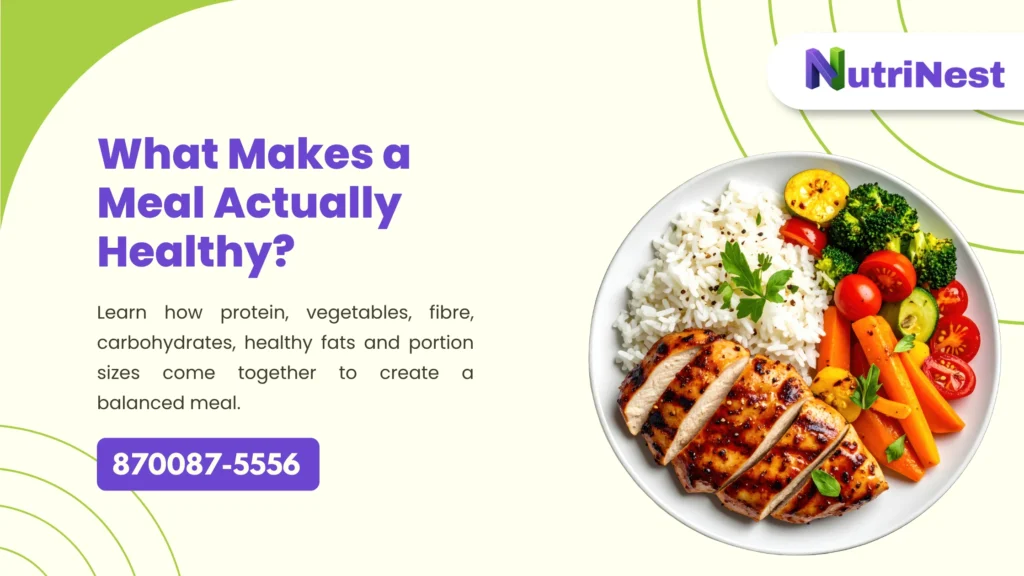
- Grilled chicken
- Mixed vegetables
- Brown rice
- A small amount of healthy fat
Example 3: Vegetarian meal
- Paneer or tofu
- Mixed vegetables
- Whole grain or millet
- Salad
Example 4: Legume-based meal
- Chickpeas or beans
- Plenty of vegetables
- Whole grain
- Curd or another suitable protein source
These aren’t rigid meal plans. They simply demonstrate – how different food groups can come together to create a more balanced meal.
6. Portion Size Still Matters
Even nutritious foods can contribute more energy than you need – if portions become consistently excessive.
At the same time – making every meal extremely small isn’t the answer either.
The right portion depends on factors such as:
- Your age
- Body size
- Activity level
- Energy requirements
- Fitness goals
- Dietary needs
- The rest of your day’s food intake
This is why there isn’t one universal plate size or calorie target that works for everyone.
Instead of obsessing over exact numbers for every meal – start by looking at the composition & then consider – whether the portion makes sense for you.
7. Pay Attention to How the Food Is Prepared
The ingredients matter – but preparation matters too.
A vegetable based meal can change considerably depending on how much oil, salt, sugar or other ingredients are added during preparation.
Similarly – frequent deep frying can change the nutritional profile of foods that may otherwise contain useful ingredients.
FSSAI’s Eat Right India initiative promotes balanced diets and encourages reducing excessive consumption of salt, sugar and saturated fats – while also emphasising food safety and hygiene.
That doesn’t mean you can never enjoy fried food or dessert.
It means – your everyday meals should not depend heavily on foods high in ingredients that are best consumed in moderation.
8. Watch the Extras You Don't Notice
Sometimes the main ingredients aren’t the biggest issue.
It’s the extras.
Consider:
- Creamy sauces
- Sugary dressings
- Excess cheese
- Fried toppings
- Large amounts of butter or oil
- Sugary beverages
- Desserts added automatically
- High sodium sauces and condiments
You don’t have to remove all of these foods from your diet.
But if you’re trying to understand “what makes a meal healthy” – it’s worth looking beyond the headline ingredient.
A “vegetable bowl” with a large amount of creamy dressing and fried toppings – can be very different from a vegetable bowl with a “balanced dressing and a clear protein source.”
9. A Salad Is Not Automatically a Complete Meal
The word “salad” – often creates an automatic association with healthy eating.
But a salad can be very different depending on – what’s inside it.
A bowl containing vegetables, a protein source, legumes or whole grains and a sensible dressing – can make a substantial meal.
A bowl containing mostly lettuce and cucumber may be refreshing and nutritious – but may not provide enough protein or energy to work as a complete meal for everyone.
So don’t judge a meal by its name.
Look at what is actually on the plate.
10. Homemade Food Isn't Automatically Healthy Either
Cooking at home gives you greater control over “ingredients and preparation.”
That’s a genuine advantage.
But homemade food can still be high in oil, sugar, salt or refined carbohydrates depending on the “recipe and portion.”
Likewise – food prepared outside the home isn’t automatically unhealthy.
The better question is –
What is in the meal, how is it prepared, and how does it fit into the rest of your diet?
This is especially useful when you’re choosing food online. Instead of relying only on words – such as “healthy”, “light” or “fitness”, look for actual information about ingredients, protein, vegetables, preparation and portions.
You can also read our guide on – How to Choose a Healthy Meal When Ordering Online for a practical checklist.
11. Variety Matters Across Your Diet
You don’t need to create a completely different meal every time you eat.
But eating a variety of foods over time – can help you obtain different nutrients and prevents your diet from becoming unnecessarily restrictive.
WHO identifies dietary diversity as – one of the core principles of a healthy diet.
That can mean rotating:
- Different vegetables
- Different fruits
- Different pulses
- Different whole grains
- Different protein sources
- Different nuts and seeds
- Different cooking methods
A healthy diet doesn’t have to be boring.
In fact – variety can make healthy eating easier to sustain.
What Should a Healthy Meal Contain?
There isn’t one universal recipe for a healthy meal.
But as a practical starting point, look for these elements:
|
Part of the meal |
What to look for |
|
Protein |
Eggs, chicken, fish, paneer, tofu, dal, beans, chickpeas or other protein-rich foods |
|
Vegetables |
A useful serving of different vegetables |
|
Carbohydrates |
Preferably nutrient-rich sources such as whole grains, pulses, vegetables or fruits |
|
Healthy fats |
Nuts, seeds, certain plant oils or other suitable sources |
|
Portion |
Appropriate for your hunger, activity and overall dietary needs |
|
Preparation |
Avoid making excessive oil, sugar or salt a regular feature |
|
Variety |
Different nutritious foods across the day and week |
The goal isn’t perfection.
It’s balance.
What Makes a Meal Healthy for Weight Loss?
A meal doesn’t become a weight-loss meal simply because it contains very few calories.
For weight management, your overall energy intake matters – but food quality, protein, fibre, portion sizes and how satisfying your meals are can also influence how practical your eating pattern is.
A useful meal may include:
A clear protein source
Plenty of vegetables or other fibre-rich foods
A sensible carbohydrate portion
A controlled amount of added fats and calorie dense extras
Your overall diet matters more than any single meal.
For more practical information, you can also explore our guide to Weight Loss Meals in Faridabad.
What Makes a Meal Healthy for Someone Who Works Out?
If you’re physically active – the same basic principles still apply.
You need a balanced diet – but your overall energy and protein requirements may be different from those of someone who is less active.
A workout focused meal might include:
Protein + carbohydrate + vegetables + appropriate fats
The exact amount depends on the person’s goals, training, body size, overall diet & other factors.
That’s why copying someone else’s “fitness meal” isn’t necessarily the right approach.
If you’re looking specifically at protein rich food choices – our guide to High Protein Meals in Faridabad can help you understand the options.
A Simple Healthy Meal Checklist
Before calling a meal “healthy”, ask yourself:
1. Where is the protein?
Can you identify a meaningful protein source?
2. Where are the vegetables or fibre-rich foods?
Does the meal contain vegetables, legumes, whole grains or other fibre rich ingredients?
3. What type of carbohydrates am I eating?
Are the main carbohydrate sources coming from nutrient rich foods?
4. What fats are included?
Are healthy fat sources present, while excessive fried or highly fatty additions are limited?
5. What has been added?
Check sauces, dressings, sugar, salt, cheese, oil and fried toppings.
6. Is the portion appropriate for me?
A nutritious food can still be eaten in an unsuitable quantity.
7. Would I be happy eating this regularly?
Healthy eating has to be practical enough to sustain.
So, What Makes a Meal Actually Healthy?
There isn’t a single ingredient that magically turns a meal – into a healthy one.
A healthy meal is about the combination.
It should provide useful nutrition – include a variety of foods, have an appropriate balance of protein, carbohydrates, fats and fibre rich foods & avoid relying heavily on – excess “sugar, salt, unhealthy fats or highly processed ingredients.”
Most importantly – the definition of a healthy meal needs to fit the person eating it.
A meal that works well for an active person – may not look exactly the same as a meal for someone with different energy needs. Cultural preferences, dietary choices & individual requirements also matter. WHO similarly notes that – the exact composition of a healthy diet varies with individual characteristics, lifestyle and dietary context.
So the next time you see a meal labelled “healthy” – don’t just look at the label.
Look at the plate.
Ask – what it provides, how it was prepared, how much you’re eating and how it fits into the rest of your day.
That’s a much more useful way to think about – healthy eating.
A Quick Note from NutriNest
At NutriNest, the focus has always been simple –
Clean, balanced, and consistent meals
Built for:
- Daily ordering
- Busy lifestyles
- Health-conscious choices
You can explore and order directly on:
And if you’ve already tried NutriNest—your review truly makes a difference.
Frequently Asked Questions (FAQs)
1. What makes a meal actually healthy?
A healthy meal generally combines “nutritious foods in a balanced way.” It may include a “protein source, vegetables or other fibre-rich foods, appropriate carbohydrates and some healthy fats” – while keeping excess sugar, salt & unhealthy fats in moderation.
2. Is a low calorie meal always healthy?
No. A low calorie meal – may still lack protein, fibre or other important nutrients. Calories are only one part of “evaluating a meal.”
3. What should a healthy meal contain?
A practical healthy meal can contain a protein source, vegetables or other fibre rich foods – a suitable carbohydrate source and an appropriate amount of healthy fat. The exact combination depends on “individual needs.”
4. Is high-protein food automatically healthy?
Not necessarily. Protein is an important nutrient – but a meal can still be unbalanced if it is missing vegetables, fibre or other important nutrients, or contains excessive amounts of salt, unhealthy fats or highly processed ingredients.
5. Are carbohydrates part of a healthy meal?
Yes. Carbohydrates can be part of a “healthy diet.” WHO recommends that “carbohydrates come primarily from sources – such as whole grains, vegetables, fruits & pulses.”
6. Is salad automatically a healthy meal?
Not necessarily. A salad can be nutritious – but its overall nutritional value depends on the – ingredients, protein source, dressing, toppings & portion size.
7. How do I know if my meal is balanced?
Start by checking – whether it contains a meaningful protein source, vegetables or other fibre rich foods – an appropriate carbohydrate source and suitable fats. Then consider portion size and added ingredients – such as sauces, sugar and excess oil.Not necessarily. A salad can be nutritious – but its overall nutritional value depends on the – ingredients, protein source, dressing, toppings & portion size.
Make Healthy Eating Simpler
Healthy eating doesn’t require every meal – to be perfect.
It requires – making better choices consistently.
Choose a variety of nutritious foods. Include protein. Eat – plenty of vegetables and other fibre rich foods. Choose better carbohydrate sources. Be mindful of “portions & added ingredients.”
And most importantly – build meals that you can actually enjoy & continue eating as part of your everyday routine.
Small steps. Big difference.