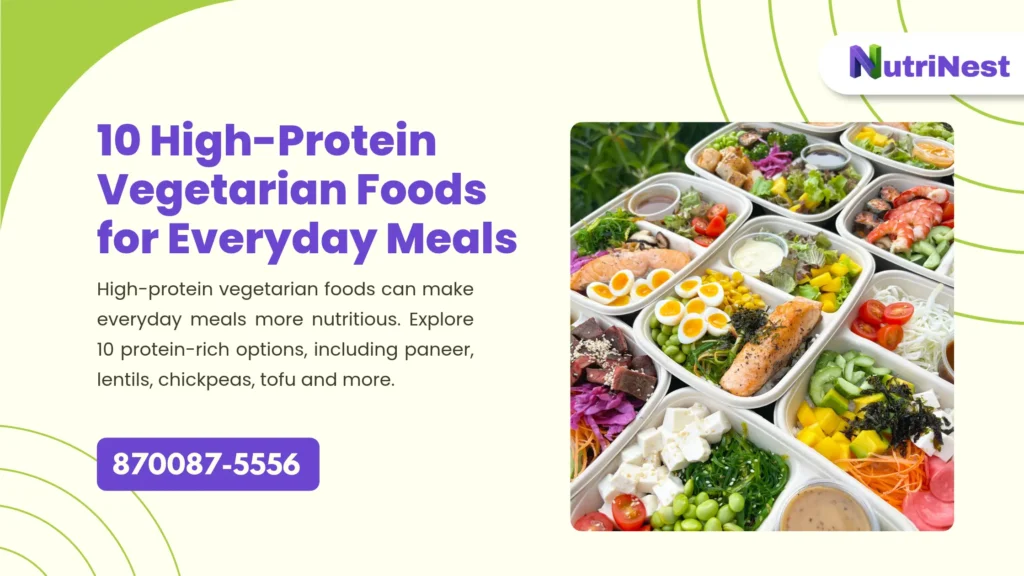
10 High-Protein Vegetarian Foods You Can Include in Daily Meals
Getting enough protein on a vegetarian diet doesn’t have to be complicated. You don’t need expensive supplements or unfamiliar ingredients – to add more protein to your everyday meals. Many commonly available Indian foods – including paneer, dal, chickpeas, soy chunks, tofu & curd – can help you increase your daily protein intake.
The important thing is knowing which foods provide protein, how much they contribute and how to include them regularly.
Whether you’re trying to build muscle, stay active, manage your food habits or simply eat more balanced meals – choosing the right high protein vegetarian foods can make a meaningful difference to your “everyday diet.”
In this guide, we’ll look at 10 protein-rich vegetarian foods, their approximate protein content, easy ways to include them in Indian meals and practical combinations to help you make better food choices.
What Are the Best High-Protein Vegetarian Foods?
Some of the commonly available vegetarian foods that provide protein include –
- Soya chunks
- Paneer
- Lentils and dals
- Chickpeas and kala chana
- Rajma
- Moong beans
- Tofu
- Milk
- Curd
- Peanuts
These foods offer different amounts of protein and other nutrients. Some are particularly protein dense – while others contribute smaller amounts that can add up across the day.
You don’t need to depend on just one food. Eating a variety of protein sources is a practical way to include more protein in a vegetarian diet.
1. Soya Chunks
Soya chunks are among the most protein dense vegetarian food options commonly available in India.
They are made from defatted soy flour and are easy to add to everyday meals. Their firm texture also makes them a useful alternative – to meat in many recipes.
How to include soya chunks in your meals:
- Add them to vegetable pulao.
- Prepare soya chunk curry with roti.
- Mix cooked soya chunks into a salad.
- Add them to wraps and rolls.
- Use them in a protein-rich lunch bowl.
Protein content: Soya chunks are generally high in protein – but the exact amount varies by product. Check the nutrition label on the packet and compare values on a dry weight basis.
NutriNest tip: When planning a vegetarian protein rich meal – soya chunks can be combined with vegetables and a suitable grain to create a more complete and satisfying meal.
2. Paneer
Paneer is one of the most familiar vegetarian protein sources in Indian households.
It is versatile, easy to prepare and works in breakfast, lunch and dinner recipes. Paneer also provides calcium – although its fat and calorie content can vary depending on how it is made.
According to the Indian Food Composition Tables 2017 – paneer contains approximately 18.9 g of protein per 100 g. Actual values can vary with the milk used & preparation method.
How to include paneer in your meals –
- Prepare paneer bhurji for breakfast.
- Add grilled paneer to a salad.
- Make paneer tikka with vegetables.
- Include paneer in a whole wheat wrap.
- Add paneer cubes to a balanced lunch bowl.
Paneer is particularly useful for people – who want vegetarian protein options without relying entirely on pulses.
However – remember that paneer also contains fat. Consider the portion and cooking method when planning your overall meal.
3. Lentils and Dals
Dal is a regular part of Indian meals – but its protein contribution is often overlooked.
Masoor dal, moong dal, urad dal and toor dal are all useful vegetarian protein sources. They also provide dietary fibre and other nutrients.
The Indian Food Composition Tables report approximately 24.4 g protein per 100 g of raw masoor dal. This is a dry weight figure – not the protein content of 100 g of cooked dal.
How to include dal in your meals –
- Have dal with roti or rice.
- Prepare moong dal chilla.
- Add cooked lentils to vegetable bowls.
- Make a lentil-based soup.
- Include dal in a balanced lunch alongside vegetables and curd.
One simple habit is to avoid treating dal as just a side dish. It can be an important part of your meal’s “protein contribution.”
4. Chickpeas and Kala Chana
Chickpeas are another practical vegetarian protein source – that can be used in several Indian and international recipes.
Both white chickpeas (kabuli chana) and black chickpeas (kala chana) can be included in everyday meals.
The Indian Food Composition Tables report approximately 18.8 g protein per 100 g of raw whole Bengal gram (kala chana).
Remember that – this is the dry food value. Once chickpeas are soaked and cooked, they absorb water – so the protein per 100 g of cooked chickpeas is lower.
How to include chickpeas in your meals –
- Prepare kala chana curry.
- Make a chickpea salad with cucumber and tomatoes.
- Add chickpeas to a vegetable bowl.
- Use boiled chickpeas in a whole-wheat wrap.
- Prepare hummus and enjoy it with suitable accompaniments.
Chickpeas are particularly useful – because they provide both protein and fibre.
5. Rajma (Kidney Beans)
Rajma is a familiar Indian comfort food – that can also contribute to your daily protein intake.
It contains plant protein along with carbohydrates and dietary fibre – making it a useful ingredient for a balanced meal.
The Indian Food Composition Tables report approximately 19.9 g protein per 100 g of raw red rajma.
This value refers to uncooked dry beans. Cooked rajma contains more water – so its protein concentration per 100 g is lower.
How to include rajma in your meals –
- Prepare rajma with rice.
- Add boiled rajma to a salad.
- Include it in a grain bowl.
- Make a rajma-based filling for wraps.
- Combine rajma with other vegetables and suitable protein sources.
Rajma doesn’t need to be eaten only with rice. You can use it in different meal combinations – to add variety to your vegetarian diet.
Food safety reminder: Always soak and cook dried kidney beans thoroughly. Undercooked kidney beans can cause illness.
6. Moong Beans
Moong beans are another useful addition to a vegetarian diet.
You can use whole green moong, split moong dal or properly prepared moong sprouts. They work well in breakfast, snacks and main meals.
The Indian Food Composition Tables report approximately 23.9 g protein per 100 g of raw split moong dal. This is the dry weight value – cooked moong dal contains less protein per 100 g because it absorbs water.
How to include moong in your meals –
- Prepare moong dal chilla.
- Make a moong dal khichdi.
- Add cooked whole moong to salads.
- Prepare a moong-based curry.
- Include properly prepared sprouts in a balanced meal.
Moong is particularly convenient – because it can be prepared in different ways without making your meals repetitive.
7. Tofu
Tofu is made from soy milk and is a useful plant based protein option.
It is especially helpful for people – who prefer dairy free meals or want more variety in their vegetarian protein sources.
The protein content of tofu varies depending on its “firmness, water content & manufacturing process.” Firm tofu generally contains more protein per 100 g than softer varieties.
Check the nutrition information on the product label – rather than assuming every type of tofu provides the same amount.
How to include tofu in your meals –
- Prepare tofu bhurji.
- Add grilled tofu to a salad.
- Make a tofu and vegetable stir-fry.
- Include tofu in a whole-grain bowl.
- Use tofu as a filling in wraps.
Tofu can be a practical alternative to paneer when you want a plant based meal.
8. Milk
Milk is a familiar source of protein that can easily fit into everyday eating habits.
Cow’s milk provides approximately 3.3 g of protein per 100 ml, although the exact amount varies with the product and processing.
While milk may not provide as much protein per serving as paneer or soya chunks, it can still contribute to your daily intake.
How to include milk in your diet –
- Have a glass of milk with breakfast.
- Add milk to oats.
- Use it in homemade smoothies.
- Include it in suitable breakfast recipes.
- Combine it with other protein-rich foods across the day.
Milk can be a convenient option for people who consume dairy products.
9. Curd (Dahi)
Curd is another familiar dairy food – that can contribute protein to vegetarian meals.
It also provides calcium and can be used in several Indian dishes.
The protein content depends on the type of curd and how it is prepared. Regular homemade curd, packaged curd and strained or Greek style yoghurt – can have different protein values.
How to include curd in your meals –
- Have plain curd with lunch.
- Prepare a vegetable raita.
- Add curd to a balanced meal bowl.
- Use plain curd as a base for a dressing.
- Combine it with oats or suitable breakfast ingredients.
If you’re specifically looking for a higher protein dairy option – compare the nutrition labels of plain strained yoghurt and regular curd. They are not nutritionally identical.
10. Peanuts
Peanuts are an affordable and easily available vegetarian food – that provide protein as well as unsaturated fats.
The Indian Food Composition Tables report approximately 23.7 g protein per 100 g of raw groundnuts.
However – peanuts are also energy dense because they contain a considerable amount of fat. This means they are best treated as a useful addition to meals – rather than an unlimited protein source.
How to include peanuts in your meals –
- Add a small portion to a salad.
- Include roasted peanuts in a snack.
- Use crushed peanuts as a topping for vegetable bowls.
- Add peanut chutney to suitable meals.
- Combine them with other nutritious ingredients.
Choose plain or lightly roasted peanuts – more often than heavily salted or sugar coated varieties.
High-Protein Vegetarian Foods: Protein Content at a Glance
The following table provides a quick reference for – comparing common vegetarian foods.
Food | Approximate protein content |
Soya chunks | Check product label; varies by brand |
Paneer | 18.9 g per 100 g |
Masoor dal | 24.4 g per 100 g dry |
Kala chana | 18.8 g per 100 g dry |
Red rajma | 19.9 g per 100 g dry |
Moong dal | 23.9 g per 100 g dry |
Tofu | Varies by firmness and brand |
Cow’s milk | 3.3 g per 100 ml |
Curd | Varies by preparation |
Peanuts | 23.7 g per 100 g raw |
Important: The raw/dry values for paneer, pulses and peanuts are based on the Indian Food Composition Tables 2017. The table’s figures are not directly comparable with cooked-serving values. Cooking changes the water content and therefore the amount of protein in a 100 g portion. For packaged products such as soya chunks and tofu, use the nutrition label for the specific product.
How to Include More Vegetarian Protein in Everyday Meals
Knowing which foods contain protein is useful – but the real challenge is including them consistently.
You don’t need to make every meal complicated. A few practical combinations can help you increase the variety of protein sources in your daily routine.
Here are some examples:
Meal | Practical vegetarian combination |
Breakfast | Moong dal chilla with curd |
Mid-morning snack | Roasted chana or a small portion of peanuts |
Lunch | Dal, roti, vegetable sabzi and curd |
Evening snack | Plain yoghurt or a suitable chickpea snack |
Dinner | Paneer or tofu with vegetables and a grain |
Alternative lunch | Rajma with rice and vegetables |
These are meal ideas – not fixed dietary prescriptions. The right portions depend on your “energy needs, food preferences & overall daily diet.”
How Much Protein Do You Need Every Day?
There is no single protein target – that works for everyone.
Your daily protein requirement can depend on:
- Age
- Body weight
- Physical activity
- Fitness goals
- Overall health
- Individual dietary requirements
Someone who exercises regularly or is working towards building muscle – may have different protein needs from someone with a less active routine.
It is also important to consider your total daily protein intake – rather than focusing on one particular food or meal.
For a more detailed explanation, read our guide: How Much Protein Do You Actually Need Every Day?
If you’re building a fitness-focused eating routine, you can also explore What Should You Eat After a Workout?.
Do You Need to Combine Different Vegetarian Protein Sources?
Eating a variety of protein sources is a sensible approach to vegetarian nutrition.
Different foods have different amino acid profiles. Pulses, grains, soy foods, dairy and nuts – can contribute different nutrients to your overall diet.
For example:
- Dal with rice
- Chickpeas with whole-wheat roti
- Paneer with vegetables and roti
- Tofu with whole grains
- Moong dal with other vegetables
You don’t need to combine every plant protein – at every meal. Eating a varied diet across the day is a practical way to include different protein sources.
The goal is to avoid depending on only “one food group.”
Common Mistakes People Make When Choosing Vegetarian Protein Foods
Even when you’re eating protein rich foods, a few common mistakes can make your diet less balanced.
1. Depending only on paneer
Paneer is useful – but it doesn’t need to be your only vegetarian protein source. Rotate it with dal, chickpeas, tofu, soya chunks and other suitable foods.
2. Assuming every dal serving provides the same protein
Protein content depends on the type of dal, the amount used and the final cooked portion. A large bowl of thin dal is not nutritionally equivalent to the same weight of dry lentils.
3. Treating nuts as your main protein source
Peanuts and other nuts contain protein, but they are also energy-dense. Use them as part of a varied diet rather than relying on them for most of your protein.
4. Choosing protein without considering the rest of the meal
A protein-rich ingredient doesn’t automatically make an entire meal balanced. Vegetables, fibre-rich foods, suitable carbohydrates and appropriate portions also matter.
For more guidance, read What Makes a Meal Actually Healthy?.
5. Ignoring the nutrition label
Packaged products can vary significantly. Compare protein values on the same measurement basis, such as per 100 g, and check the ingredients and serving size.
How NutriNest Can Make Protein-Rich Eating More Convenient
Knowing which vegetarian foods contain protein is one part of eating better. Making time to plan, prepare and include balanced meals every day can be another challenge.
This is particularly true for working professionals, people with busy schedules and those trying to maintain a consistent food routine.
At NutriNest, we focus on making everyday healthy eating more convenient through fresh meal options, including protein-focused choices.
If you’re exploring convenient meal options, you can:
- Explore High Protein Meals in Faridabad for protein-focused meal choices.
- Check Gym Diet Meals in Faridabad if you’re looking for convenient meals around an active lifestyle.
- Explore our Healthy Meal Subscription Plans in Faridabad if you want to make planned meals part of your regular routine.
- If you’re nearby, learn more about Healthy Food Delivery in Sainik Colony, Faridabad.
You don’t have to change your entire diet overnight. Start by choosing suitable protein sources, making your meals more balanced and building a routine you can maintain.
And if planning every meal becomes difficult, choosing a convenient, balanced meal option from NutriNest may make that routine easier.
A Quick Note from NutriNest
At NutriNest, the focus has always been simple –
Clean, balanced, and consistent meals
Built for:
- Daily ordering
- Busy lifestyles
- Health-conscious choices
You can explore and order directly on:
And if you’ve already tried NutriNest—your review truly makes a difference.
Frequently Asked Questions About High-Protein Vegetarian Foods
1. What are the 10 best high-protein vegetarian foods?
Ten useful vegetarian protein sources are soya chunks, paneer, lentils, chickpeas, rajma, moong beans, tofu, milk, curd and peanuts. Their protein content varies, so combining different sources can help you include more protein in your daily diet.
2. Which vegetarian food has the highest protein?
Among the foods covered in this article, soya chunks are generally among the most protein-dense options. Their exact protein content depends on the brand, so check the nutrition label. Dry lentils, moong dal and peanuts are also relatively protein-rich foods.
3. How can vegetarians get enough protein every day?
Vegetarians can include protein from different food groups, such as dals, beans, chickpeas, paneer, milk, curd, tofu, soya chunks and nuts. Including a suitable protein source in main meals and varying food choices throughout the day can help.
4. Which Indian vegetarian foods are rich in protein?
Common Indian vegetarian protein-rich foods include masoor dal, moong dal, rajma, kala chana, paneer, soya chunks and peanuts. These ingredients can be used in familiar meals such as dal, chilla, curries, salads, wraps and bowls.
5. Is paneer a good source of protein?
Yes. Paneer is a useful vegetarian protein source and provides approximately 18.9 g of protein per 100 g in the Indian Food Composition Tables 2017. Its actual nutritional content can vary depending on how it is prepared.
6. Are dal and rice enough protein for a vegetarian meal?
Dal and rice both contribute protein, and eating them together provides a combination of plant-based protein sources. However, whether a particular portion meets your protein needs depends on how much you eat and your overall daily diet. Adding vegetables, curd or another suitable protein source can make the meal more varied.
7. Can vegetarians build muscle without eating meat?
Yes. A vegetarian diet can support muscle building when it provides sufficient total energy, protein and other essential nutrients. Foods such as soya chunks, paneer, tofu, dals, beans and dairy can help supply protein. Training, recovery and individual dietary requirements also matter.
8. Are soya chunks better than paneer for protein?
Soya chunks generally provide more protein per 100 g of dry product than paneer. However, the two foods differ in fat, water content, preparation and serving size. Compare their nutrition labels and consider which option fits your meal and dietary preferences.
9. What are some easy high-protein vegetarian breakfast options?
Moong dal chilla, paneer bhurji, besan chilla, curd with suitable breakfast ingredients and tofu bhurji are practical vegetarian breakfast ideas. The protein content depends on the ingredients and portions used.
10. Can I get protein from vegetarian snacks?
Yes. Roasted chana, peanuts, plain yoghurt, milk and suitable legume-based snacks can contribute protein. Choose portions that fit your overall diet, and remember that a snack does not need to replace a balanced main meal.
Final Thoughts
Eating a protein rich vegetarian diet doesn’t have to mean following complicated recipes or depending on expensive ingredients.
Everyday foods – such as “dal, paneer, chickpeas, rajma, soya chunks, tofu, milk, curd and peanuts can all contribute to your protein intake.”
The key is to include a variety of these foods, pay attention to portions & make protein part of a balanced eating routine.
Whether your goal is to support an active lifestyle, build muscle or simply improve your everyday food choices – small and consistent changes can help.
Choose nutritious foods, keep your meals varied and make healthy eating practical enough to follow every day